
Technical Articles
Why Castings Need Heat Treatment & Its Functions
Meta description: Learn why castings need heat treatment, its main functions including stress relief, grain refinement, hardness adjustment, and the basic principle of heating, holding and cooling.
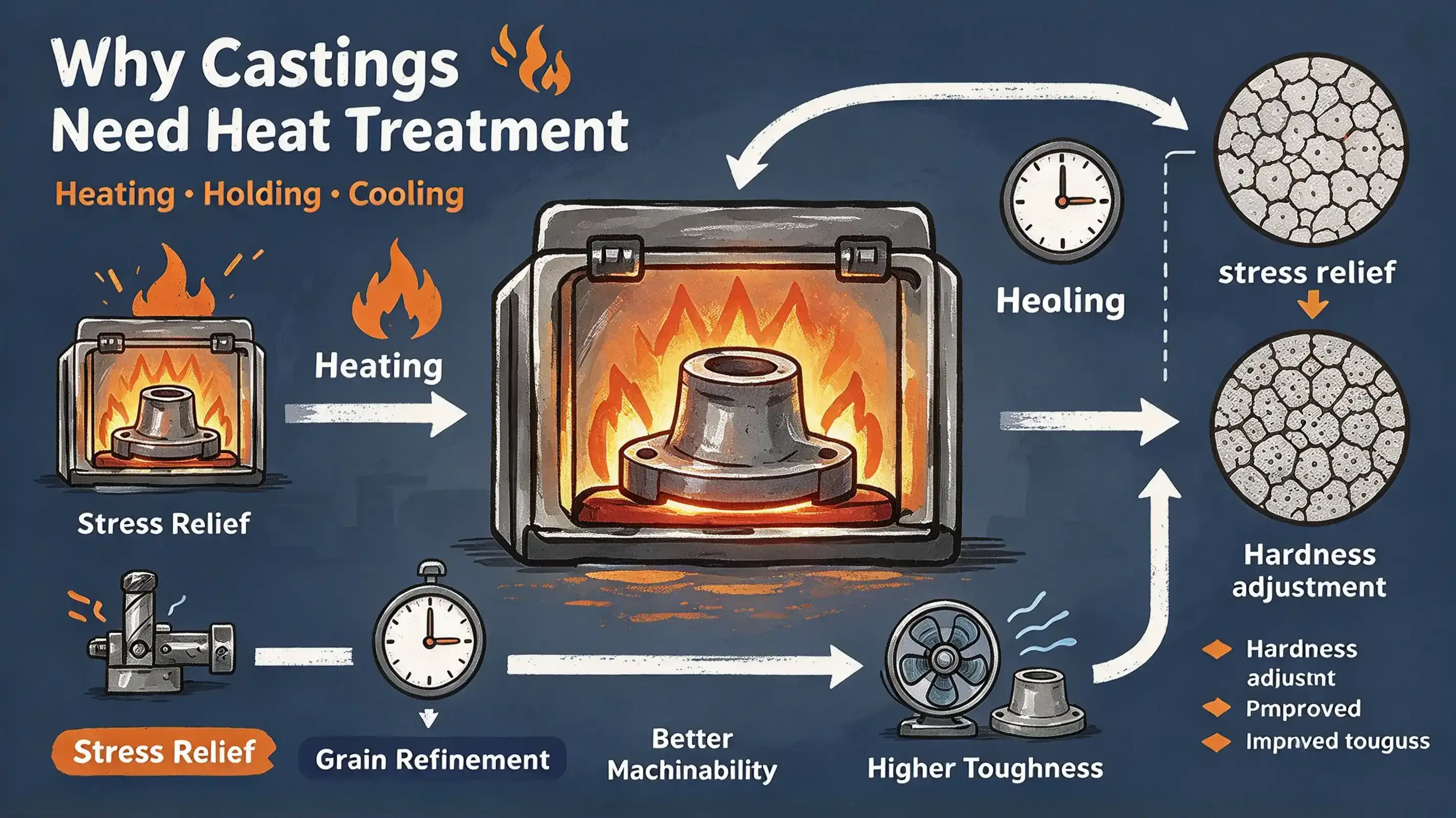
Heat treatment is an essential process for metal castings. It can adjust the internal microstructure of castings and optimize comprehensive mechanical properties, which directly affects the processing performance and service life of casting parts.
1. Purposes and Functions of Casting Heat Treatment
- Relieve Internal Casting Stress Uneven thickness and inconsistent shrinkage during solidification of castings will produce residual internal stress, which easily causes deformation and cracking. Stress-relief annealing releases residual stress, ensuring no deformation during subsequent machining and application.
- Improve Metallographic Structure and Refine Grains As-cast structure features coarse grains, porosity and serious segregation. Heat treatment refines grains to enhance the strength and toughness of castings.
- Adjust Hardness for Convenient Machining Hard as-cast material is difficult to cut. Annealing or normalizing reduces hardness for easy machining. For working surfaces requiring wear resistance, quenching and tempering are adopted to increase hardness.
- Improve Comprehensive Mechanical Properties (Strength, Toughness, Wear Resistance) For gears, valves and wear-resistant castings, quenching and tempering processes balance toughness and wear resistance, raising strength, toughness and wear resistance simultaneously.
- Homogenize Chemical Composition (Diffusion Annealing) Solve the defects of element segregation and uneven microstructure inside castings to make composition uniform.
- Boost Corrosion Resistance and Heat Resistance Applicable to stainless steel and heat-resistant cast steel, to obtain excellent corrosion-resistant and high-temperature-resistant performance.
2. Basic Principle of Heat Treatment
Solid metal undergoes reversible phase transformation of internal crystal structure with temperature rise and fall.
- Heating Heat up to the critical temperature. The matrix structure (ferrite, pearlite, etc.) transforms into austenite with atomic diffusion and reorganization.
- Holding Keep the temperature for a period of time to guarantee sufficient phase transformation and uniform composition inside and outside the workpiece.
- Cooling Different microstructures can be obtained by controlling cooling rate:
- Slow cooling (furnace cooling): pearlite structure, soft and easy to machine (Annealing)
- Air cooling: fine pearlite, medium strength (Normalizing)
- Rapid cooling (water/oil quenching): martensite, high hardness (Quenching)
Tempering Reheat at low, medium or high temperature after quenching. It eliminates quenching stress and reduces brittleness, achieving tough microstructure with better overall performance.