
Sep 9, 2026Technical Articles
Required Properties of Molding and Core Sand
Learn seven key performance indicators for foundry molding sand & core sand: strength, permeability, refractoriness, yield, disintegration, flowability and plasticity.
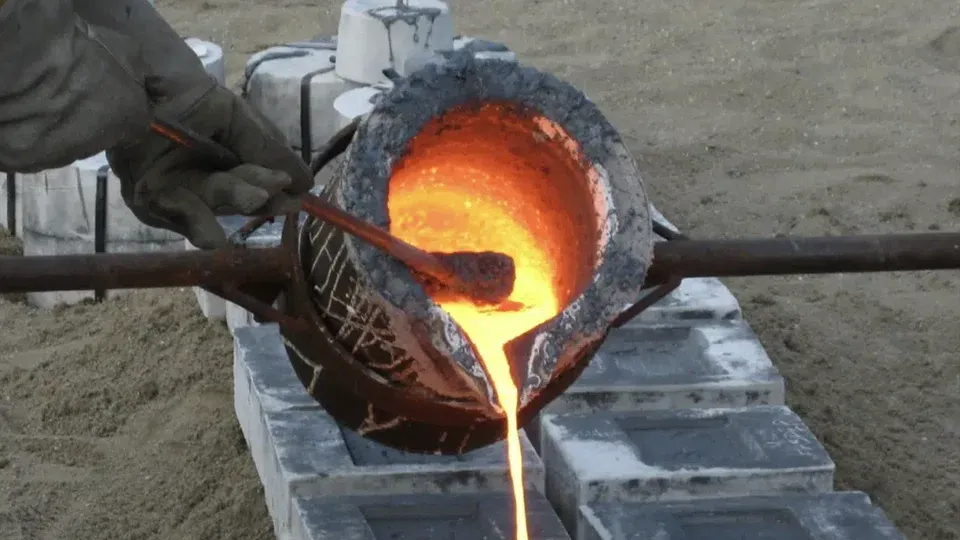
High-quality molding sand must possess a full set of essential properties to produce sound castings.
(1) Strength Strength refers to the ability of molding sand to resist external force without damage. Adequate strength keeps the mold intact during pattern stripping, mold turning, handling and molten metal pouring. Insufficient strength causes mold collapse and sand wash, leading to casting defects such as sand holes and distortion. However, excessively high strength impairs mold permeability and casting shrinkage, resulting in gas porosity and hot cracks.
For clay-bonded sand, higher clay content and greater compaction improve strength; finer sand grains also raise strength. Both excessive and insufficient moisture reduce molding sand strength.
(2) Permeability Permeability describes the capacity for gas to pass through voids inside sand mass. Poor permeability prevents large volumes of gas generated during high-temperature metal pouring from escaping the mold cavity, which may cause blowholes, gas defects and misrun.
Coarse, uniform and round original sand grains, low clay content and lower compaction all help boost permeability. Too much or too little moisture will reduce permeability.
(3) Refractoriness Refractoriness is the capability of sand to withstand high temperature from molten metal without melting or sintering. Low refractoriness makes sand grains adhere to casting surfaces and form hard crusts, increasing cleaning and machining difficulty, and even causes casting rejection in severe cases.
Higher SiO₂ content and larger grain size raise refractoriness. Coating the cavity surface with anti-burning materials such as graphite coating is commonly used to compensate insufficient refractoriness.
(4) Collapsibility / Yield (Giveaway Property) Yield (giveaway) is the property that allows molding sand to be compressed as the casting shrinks during solidification. Insufficient yield creates high resistance against casting shrinkage, inducing internal stress, distortion and even cracks. Higher compaction leads to poorer yield performance.
(5) Shakeout Property (Disintegration Property) Disintegration property means the sand can break down easily after pouring. Good disintegration reduces labor work for shakeout and cleaning. It depends on sand formulation and binder type.
(6) Flowability Flowability is the ability of sand grains to move relative to each other under external force or self-weight. Sand with good flowability fills and compacts easily, forming mold cavities with uniform compaction, sharp contours and smooth surfaces. It cuts ramming labor and improves production efficiency.
(7) Plasticity Plasticity is the capacity of sand to deform under external force and retain its shape after force removal. Sand with good toughness is soft and deformable, resisting breakage and falling-off during pattern stripping and mold repairing. Sprinkling water around the pattern during manual molding increases local moisture to improve sand toughness.
Cores suffer severe impact from molten metal and are fully surrounded by high-temperature liquid metal during pouring. Therefore, core sand requires higher strength, refractoriness, permeability, yield and disintegration than molding sand. Specially-formulated core sand is adopted, such as raising clay and fresh sand content to enhance strength and refractoriness. Tung oil sand, synthetic fat sand and resin sand are selected for intricate cores with high strength requirements. Sawdust is often added into large complex cores to improve yield property.
👉Fused ceramic spherical sand optimizes these critical sand properties for your mold and core production. View our Fused Ceramic Sand Product Page