
Sep 8, 2026Technical Articles
Key Elements in the Casting Process
Understand six key elements of casting process: mold, pattern, molten metal, gating system, riser, cooling‑solidification control. Master core factors to avoid casting defects and improve part quality
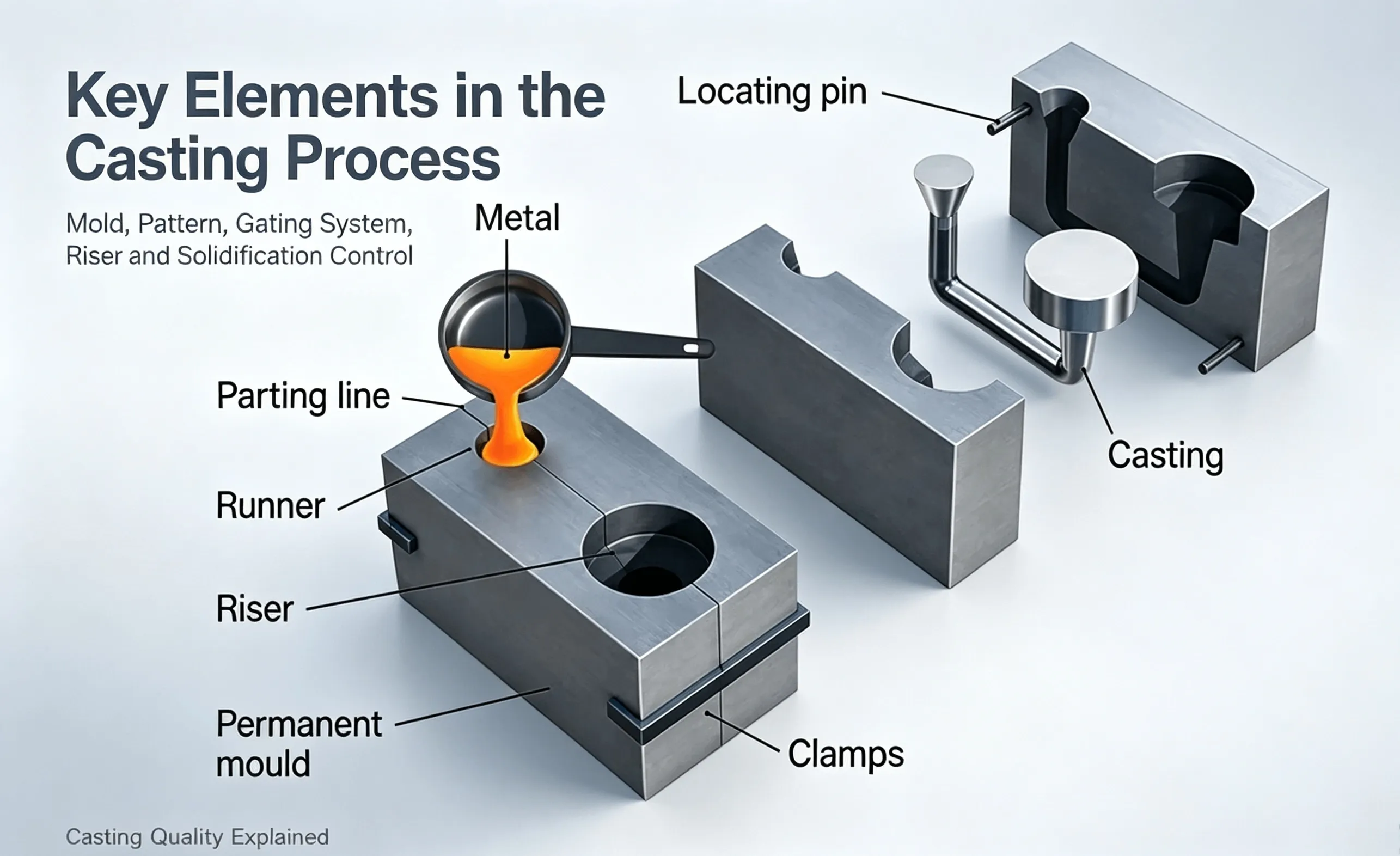
Successful casting operations rely on the coordination of multiple critical elements. The mold defines component geometry, molten metal forms the part body, and gating‑plus‑cooling design ensures proper filling and solidification. Poor control of any single element will compromise final casting quality.
Mold
A mold is a hollow structure that delivers the final shape of castings. Its inner cavity defines major geometries, including outer profiles, internal passages, ribs, bosses and other structural features.
A qualified mold must withstand high pouring temperature, metal flow and pressure during casting. It also requires high dimensional accuracy to keep castings close to target dimensions. Poor‑quality molds lead to surface defects, dimensional deviations and inconsistent part performance.
Pattern
Patterns are widely used to create mold cavities, especially in sand casting processes. A pattern replicates the part shape, yet adjustments are required to compensate for metal shrinkage, machining allowance and draft for demolding.
Pattern dimensions are not identical to finished castings. Professional casting design must account for metal behaviors after pouring and cooling. Therefore, pattern design directly determines casting accuracy and manufacturability.
Molten Metal
Molten metal is liquid feedstock filling the mold cavity, which solidifies into the final casting. Its temperature, cleanliness and fluidity strongly influence cavity filling performance.
Insufficient fluidity causes incomplete filling for thin‑wall sections or complex geometries. Excessive gas, slag or inclusions deteriorate internal casting quality. Stable molten‑metal preparation is essential for consistent casting results.
Gating System
The gating system acts as the passage to deliver molten metal into mold cavities, generally consisting of sprue, runner and ingate. It controls metal entry mode and filling speed across different cavity zones.
Well‑designed gating systems reduce turbulence, air entrapment and uneven filling. Beyond transporting liquid metal, it optimizes flow paths for uniform casting formation.
Riser
A riser is an auxiliary molten‑metal reservoir connected to castings. Its core function is to feed liquid metal to regions undergoing solidification shrinkage.
Metal shrinks during cooling; risers supply extra material to offset volume loss. Properly engineered risers minimize shrinkage‑related defects and improve internal soundness of castings.
Cooling & Solidification Control
Cooling and solidification govern how liquid metal transforms into stable solid components. Cooling rate affects dimensional stability, microstructure, mechanical properties, as well as risks of stress and distortion.
Fast cooling is not always the target. Controlled, balanced cooling is preferred in most scenarios. Rational solidification management preserves target geometry and lowers internal defect risks.
🎁For reliable casting performance, select high‑quality fused ceramic sand to optimize your mold‑making workflow. View our Fused Ceramic Sand Product Page.