
Aug 17, 2026Technical Articles
High‑Strength Easy‑Filling Coated Sand Blended with Ceramsite Sand to Solve Thin‑Wall Core Defects
Precoated sand blended with ceramsite sand improves thin‑wall casting core performance. Learn formula, process and test data for auto engine precision casting.
Abstract
Thin and complex waterway cores for auto engine cylinder heads suffer from poor filling, high‑temperature deformation, cracks, gas porosity and dimensional tolerance errors when using full‑silica precoated sand. Based on industrial test data, this article introduces the optimal formula, production process and field performance of silica sand mixed with ceramsite sand. The composite coated sand greatly improves core strength and flowability, reduces gas evolution, raises casting yield above 90%, and achieves over 95% thermal sand reclamation rate, balancing casting quality and production cost.
1. Drawbacks of Traditional Silica Coated Sand
With lightweight auto engines developing rapidly, internal cooling channels are extremely complicated, with core wall thickness as thin as 2‑3 mm. Conventional pure silica coated sand has critical production problems:
- Angular grains lead to poor flowability, incomplete core filling, only about 50% core pass rate.
- Low hot strength causes core deformation and breakage during pouring, resulting in uneven wall thickness.
- Large specific‑surface area requires high resin dosage, generating excessive gas and porosity defects.
- High thermal expansion of silica sand triggers metal penetration, veining and heavy cleaning workload.
2. Core Advantages of Ceramsite Sand
Ceramsite sand is spherical artificial foundry sand made of high‑alumina bauxite, outperforming silica sand in all key indicators for coated‑sand production:
- Perfect spherical shape, angularity coefficient <1.1: low friction, excellent flowability for narrow thin cavities.
- Small specific‑surface area: less resin consumption and lower gas emission under equal core strength.
- Ultra‑low thermal expansion & high refractoriness: avoids casting deformation and burn‑on.
- High hardness & good shake‑out property: over 95% reclamation rate with low pulverization.
- Chemically neutral: compatible with phenolic resin for precoating process.
3. Optimal Mix Ratio & Additive Dosage
Base Sand Mix (70‑140 mesh, grain concentration ≥85%)
‑ Ceramsite sand: 20%‑30%‑ Silica sand: 70%‑80%25% ceramsite sand is recommended for balanced cost & performance.
Additive Proportion (based on total raw sand weight)
- Phenolic resin: 1.2%‑1.6%
- Lubricant: 0.05%‑0.2%
- Curing agent: 10%‑20% of resin weight
4. Standard Hot‑Coating Production Process
- Heat raw sand to 130‑170 ℃ in muller.
- Add phenolic resin, mix for 60 s, add half lubricant and stir 120 s.
- Cool sand to 100‑110 ℃, input curing agent.
- Add remaining lubricant, mix 40‑50 s.
- Discharge at 60‑80 ℃, crush and screen.
- Cool to 25‑35 ℃ for sealed packaging.
5. Performance Comparison Chart
Index | Conventional Silica Coated Sand | Ceramsite Blended Coated Sand | Improvement |
|---|---|---|---|
Cold bending strength | >3.0MPa | >4.5MPa | +50% |
Hot bending strength | >1.5MPa | >2.5MPa | +67% |
Gas evolution | <15mL/g | <12mL/g | 20% reduction |
Loss on ignition | <2.0% | <1.6% | Less VOC emission |
Core forming pass rate | ~50% | 94%+ | Sharp rise |
Final casting yield | Below 30% | 91%+ | Defects greatly eliminated |
6. Field Application on Auto Cylinder Head Cores
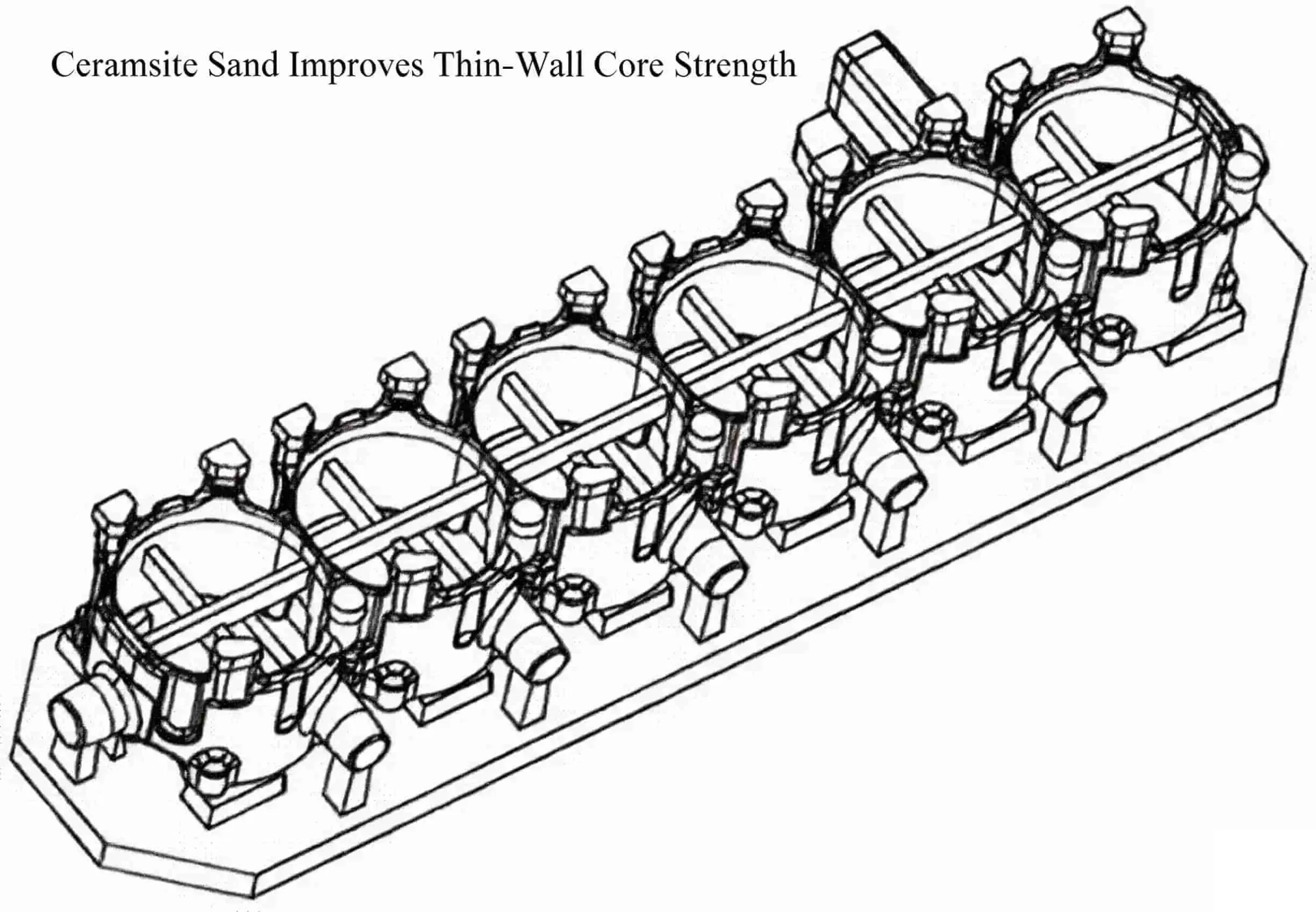
Test on turbo engine thin waterway cores (minimum wall thickness 3.3 mm):
- Pure silica sand: incomplete filling, bent or broken cores, frequent porosity, deformation and burn‑on, casting yield below 30%, heavy manual repair work.
- Ceramsite blended sand: complete, smooth cores without cracks or warpage. Castings keep stable dimensional tolerance, no hot breakage, porosity or metal penetration. Easy shake‑out with 95%+ sand reclamation rate.
Production control tips‑ Store finished cores within 48 h in high‑humidity workshops.‑ Enlarge vent plugs on core prints to reduce gas defects.
7. Conclusion
Coated sand mixed with 20%‑30% 70‑140 mesh ceramsite sand solves typical defects of thin complex cores including poor filling, high‑temperature deformation and gas porosity. It lowers resin consumption and improves sand reusability, ideal for mass production of high‑precision aluminum castings such as auto engine parts and hydraulic valve bodies.
End‑of‑article link
View spherical sintered ceramsite sand specially formulated for coated sand process, full grain specs & free test samples available:Ceramic Ceramsite Sand Product Page