
Technical Articles
Heat Treatment Phase Transformation: Pearlite, Bainite & Martensite
Understand steel phase transformation in heat treatment. Compare austenite, pearlite, bainite & martensite and pick the right annealing, quenching & tempering.
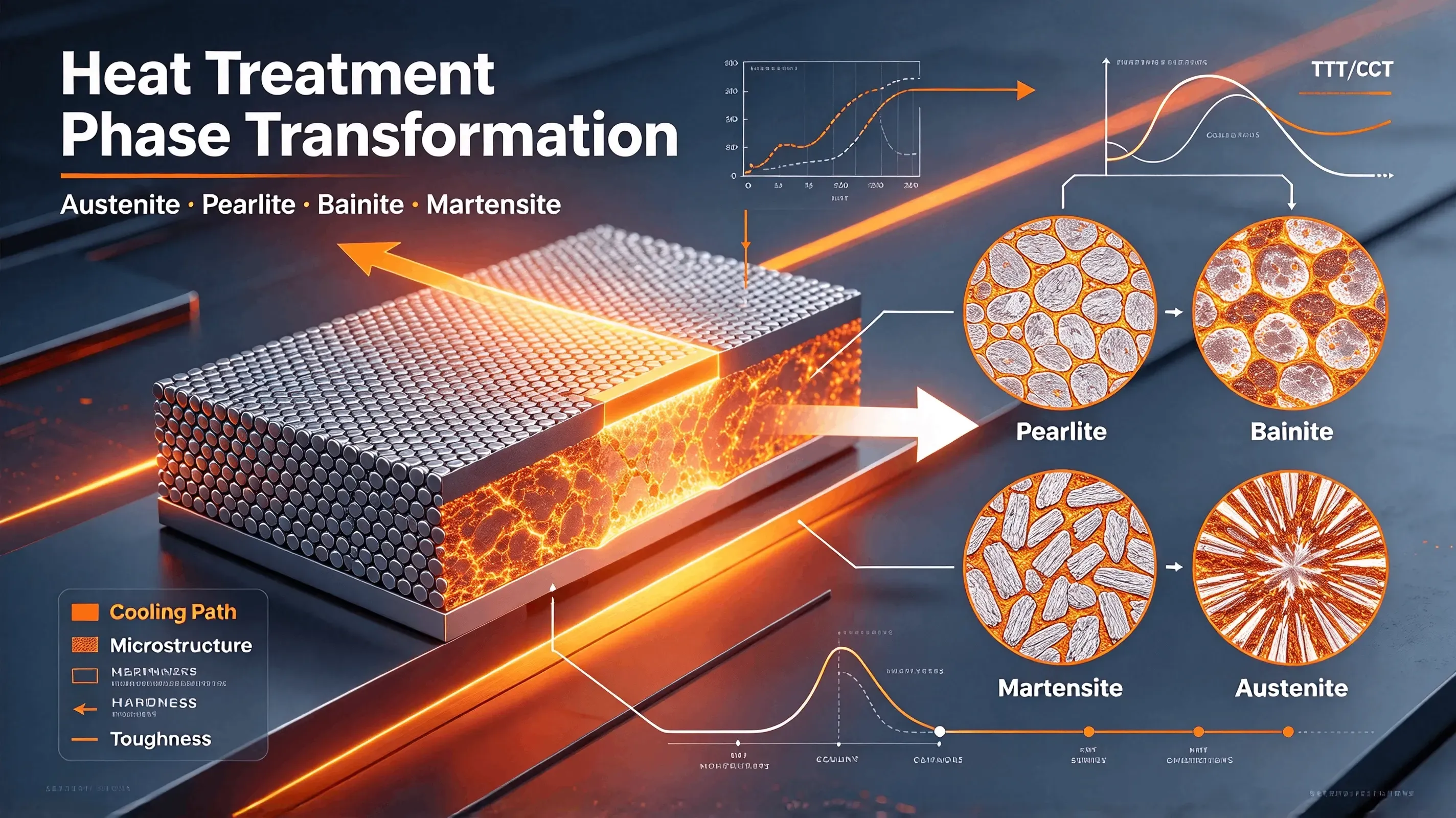
Same piece of steel can achieve completely different hardness, strength, toughness and dimensional stability simply by adjusting heating temperature, holding time and cooling method. Annealing improves machinability; quenching greatly boosts hardness; austempering balances strength and toughness. All these changes originate from the evolution of steel microstructure.
Many practitioners remember a simplified rule: pearlite is soft while martensite is hard. However, the final microstructure is not governed by cooling rate alone. Steel chemical composition, austenitizing condition, workpiece size and transformation time all play critical roles.
The logic of heat treatment phase transformation can be summarized in one clear line: form qualified austenite by heating first, then transform austenite into pearlite, bainite or martensite via different cooling routes.
1. Core Concepts
Strictly speaking, austenite and ferrite are solid-solution phases, cementite is an intermetallic compound. Pearlite and bainite are microstructures assembled from multiple phases, and martensite is a metastable phase generated by diffusionless transformation of austenite.
In workshop communication, these structures are generally referred to as metallographic structures, which is acceptable. Still, it is necessary to distinguish basic definitions when studying phase transformation: Ferrite is an interstitial solid solution of carbon in α-Fe with a body-centered cubic lattice. It has low carbon solubility, low hardness and good ductility. Cementite, Fe₃C, features high hardness and high brittleness. Pearlite is a lamellar structure formed by alternating ferrite and cementite.
Three fundamental diagrams support heat treatment analysis:
- Iron-carbon phase diagram: defines stable phases of steel with fixed composition under equilibrium conditions at different temperatures.
- TTT (Time-Temperature-Transformation) curve: records the start and finish time of austenite transformation during isothermal holding at constant temperatures.
- CCT (Continuous Cooling Transformation) curve: describes microstructure evolution of austenite under continuous cooling.
Normalizing, quenching and furnace cooling in mass production mostly belong to continuous cooling processes, so CCT curves match real production conditions better. Note that TTT and CCT curves cannot be copied indiscriminately. Any change in steel grade, austenitizing temperature, austenite grain size or undissolved carbides will shift these curves.
Austenite is the starting point, and cooling path determines the final microstructure.
2. Austenite: The Parent Phase
Austenite acts as the key parent phase for annealing, normalizing, quenching and isothermal heat treatment. It adopts a face-centered cubic crystal structure. The octahedral gaps inside its lattice accommodate carbon atoms easily, giving austenite much higher carbon solubility than ferrite.
Austenite in ordinary carbon steel is unstable at room temperature. It will decompose into other microstructures as temperature drops. If transformation is incomplete, retained austenite can remain at ambient temperature. Adding nickel, manganese and other austenite-stabilizing elements expands its stable temperature range, which is why austenitic stainless steels retain austenite as the major phase at room temperature.
Austenitizing is more than heating steel until it glows red. Insufficient temperature fails to fully transform original ferrite, pearlite or carbides. Excessive temperature or prolonged holding leads to coarse austenite grains, oxidation and decarburization without proper protection.
For full austenitization of hypoeutectoid steel, heating above Ac₃ is required. Hypereutectoid steel for quenching is commonly heated between Ac₁ and Acm, preserving appropriate undissolved carbides and restraining grain growth. Heating parameters must be customized according to steel grade, initial microstructure, part dimension and performance target.
The quality of austenite lays the foundation for subsequent phase transformation. Uniform austenite with proper grain size is essential to obtain expected structures after cooling.
3. Pearlite: Diffusion-Controlled Transformation
When austenite is held at relatively high temperature for sufficient time, carbon atoms diffuse adequately and pearlite forms. Pearlite is the eutectoid transformation product of austenite, consisting of alternating ferrite and cementite lamellae. It is a typical diffusion-type transformation product because carbon redistribution is required during formation.
Pearlite performance depends heavily on interlamellar spacing. Transformation at higher temperature allows sufficient carbon diffusion and produces coarse pearlite with wide lamellar spacing. Lower transformation temperature raises nucleation rate and creates fine pearlite with narrow spacing. For the same steel grade and similar phase fraction, fine pearlite delivers higher strength and hardness than coarse pearlite. The coarse microstructure from annealing and finer structure from normalizing in production is explained by this rule.
Slow cooling does not guarantee full pearlite. Hypoeutectoid steel precipitates proeutectoid ferrite first, and the residual austenite transforms into pearlite afterwards. Hypereutectoid steel may separate proeutectoid cementite before the remaining austenite turns into pearlite.
Pearlite possesses balanced mechanical properties and good machinability. It is widely found in structural steel, medium carbon steel, rail steel and steel wire. Adjusting pearlite fraction and lamellar spacing can tailor strength, ductility and wear resistance.
4. Bainite: Medium-Temperature Transformation Product
If transformation temperature drops further, carbon diffusion is restricted, yet the temperature is still above the martensite start point. Under this condition, austenite transforms into bainite.
Bainite is NOT a simple mixture of pearlite and martensite. It is an independent transformation product with unique forming conditions and morphology. Multiple theoretical models explain its formation. Practically, bainitic ferrite forms via shear mechanism, followed by carbon partitioning or carbide precipitation.
Bainite in conventional carbon and alloy steel is divided into upper bainite and lower bainite:
- Upper bainite forms at higher temperature, featuring lath bundles or feather-shaped ferrite with carbides distributed between ferrite laths.
- Lower bainite forms at lower temperature with finer structure; carbides precipitate inside or between bainitic ferrite laths.
This classification cannot be applied to all steel types. For example, high-silicon carbide-free bainitic steel suppresses carbide precipitation and retains carbon-enriched retained austenite, showing distinct morphology and performance.
For identical steel grade and comparable processing conditions, the hardness and strength of bainite sit between pearlite and untempered martensite. Refined lower bainite achieves excellent strength-toughness combination. Its final performance depends on chemical composition, structural scale, carbide morphology and retained austenite content.
5. Martensite: Diffusionless Transformation under Rapid Cooling
When austenite cools fast enough to avoid ferrite, pearlite or bainite formation, martensite starts to nucleate once temperature falls below Ms (Martensite start temperature).
Martensite transformation relies on coordinated atomic displacement instead of long-range carbon diffusion. Carbon atoms are trapped supersaturated in the lattice, forming body-centered tetragonal martensite in carbon steel, accompanied by severe lattice distortion, high dislocation density and internal stress.
Quenched martensite in most commercial steels exhibits athermal transformation characteristics. Martensite fraction mainly depends on the cooling temperature rather than extended holding time at a fixed temperature below Ms. If Mf (Martensite finish temperature) is below room temperature, partial untransformed austenite remains as retained austenite after cooling. Retained austenite affects hardness, dimensional stability and service behavior. Cryogenic treatment plus tempering, multiple tempering or alloy design can stabilize or reduce retained austenite as required.
Martensite in low-carbon steel is mostly lath-type with decent strength and toughness. Higher carbon content increases the proportion of plate martensite, raising hardness along with quenching stress, brittleness and cracking risk.
Two key distinctions: Cooling rate mainly determines whether diffusion-type transformations can be suppressed to obtain martensite. The maximum achievable hardness of martensite is primarily controlled by carbon content.
Once the part reaches nearly full martensitic structure, further accelerating cooling will not continuously increase hardness, but greatly raises deformation and cracking risk. Quenching does not mean ultra-fast cooling; a balance between target microstructure and distortion control is necessary.
6. Performance Comparison: Hardness, Hardenability & Hardenability
For the same steel grade, similar phase fraction and untempered state, the general hardness ranking is: Martensite > Bainite > Fine Pearlite > Coarse Pearlite
This trend is only a rough reference and cannot be used to compare different steel grades without considering composition and heat treatment status. Austenite cannot be simply added into this sequence, because its properties vary greatly whether it is high-temperature parent phase or low-temperature retained austenite.
Hardenability and hardening capacity are two different concepts for quenching evaluation:
- Hardening capacity: the maximum hardness obtainable after proper quenching, dominated by carbon content.
- Hardenability: the ability to form a hardened layer with required depth under specified quenching conditions, related to alloy elements, austenite grain size, cooling rate and workpiece thickness.
A small test sample that can be fully martensitic does not guarantee full hardening of heavy-section components. The surface of one part cools rapidly to form martensite, while the slowly cooled core may form bainite, pearlite or mixed structures.
Heat treatment quality assessment requires comprehensive inspection including surface hardness, effective hardened depth, core microstructure, retained austenite level, distortion and mechanical properties, instead of single hardness testing.
7. How to Select Suitable Heat Treatment Processes
Four questions help judge the right heat treatment route:
- Base material: carbon content and alloy elements define critical temperatures, hardenability, Ms point and TTT/CCT curves.
- Austenitizing quality: heating temperature, holding time, carbide dissolution and grain size dominate all subsequent transformation.
- Cooling curve path: the relative position between actual cooling curve and CCT curve decides whether austenite turns into ferrite, pearlite, bainite, martensite or mixed microstructures.
- Tempering requirement: as-quenched martensite has high hardness yet huge internal stress and poor toughness, rarely used as final state. Tempering facilitates carbon redistribution and carbide precipitation, relieves residual stress and optimizes strength-hardness-toughness matching.
Common process selection guide:
- Reduce hardness and improve machinability: annealing for ferrite, pearlite or spheroidized microstructure.
- Refine grain and optimize comprehensive performance: normalizing.
- High hardness and wear resistance: quenching + tempering to get tempered martensite.
- Minimize distortion while keeping balanced strength and toughness: austempering to produce bainite, subject to steel hardenability and part size.
In essence, heat treatment is far more than simple heating and cooling. It is the precise control of austenite formation and decomposition paths. Pearlite forms with sufficient carbon diffusion and presents lamellar morphology. Bainite is the unique microstructure formed within medium temperature transformation zone. Martensite is the diffusionless metastable phase generated under rapid quenching.
Mastering the link among alloy composition, austenitizing, cooling schedule and tempering allows you to fully understand steel microstructure evolution and the intrinsic logic of annealing, normalizing, quenching, tempering and isothermal treatment.