Buying Guide
Fused Ceramic Sand – Introduction, Production Process, Properties & Applications
Fused ceramic sand (fused ceramsite sand) is eco-friendly foundry sand with high refractoriness, low expansion. Suitable for precoated sand, lost foam, resin sand casting. Stable AFS grades & mesh
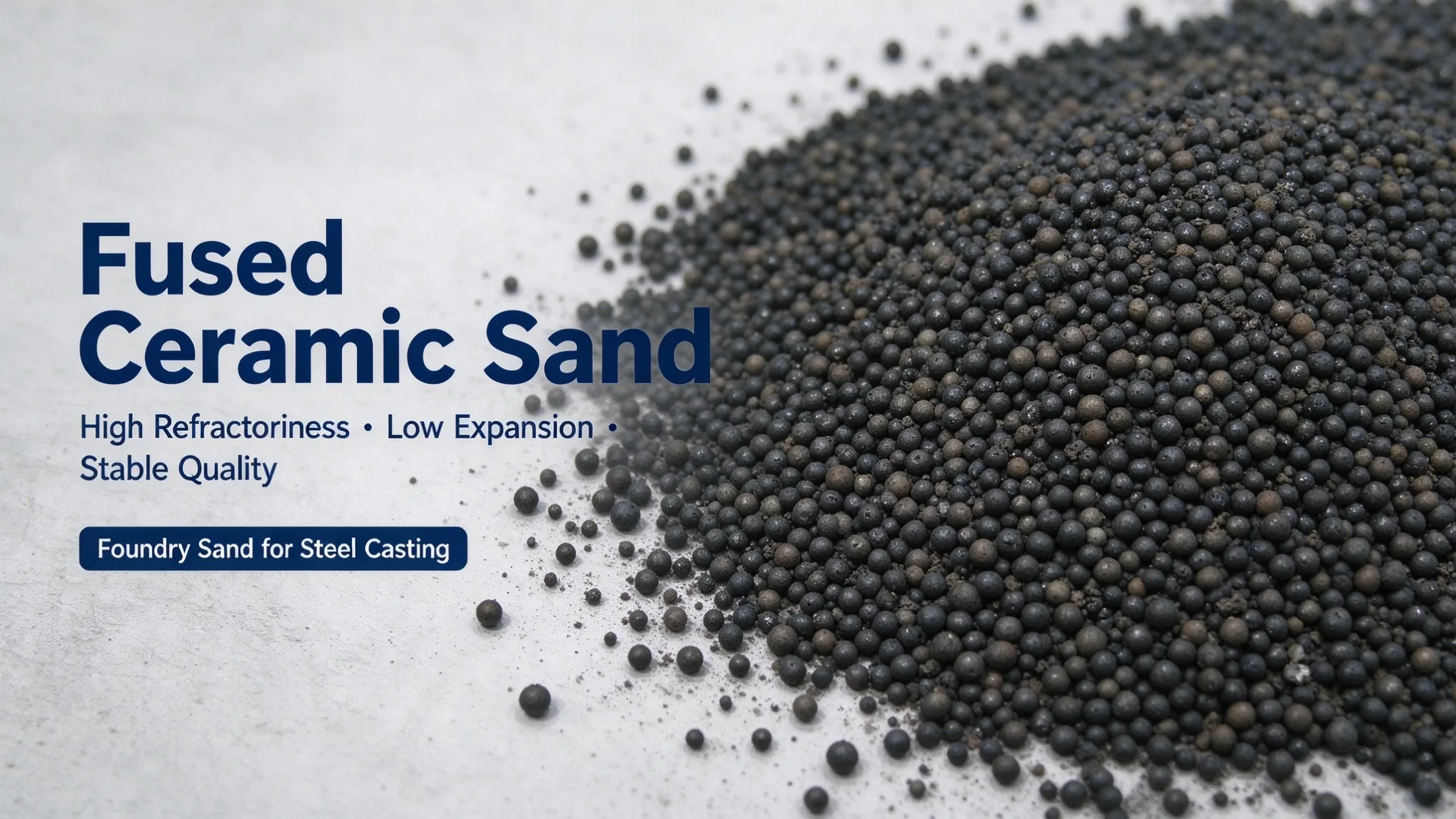
Fused Ceramic Sand, also known as fused ceramsite sand, is an eco-friendly refractory grain for foundry industry.
1. Raw Materials & Manufacturing Principle
Fused ceramic sand is produced from high-quality bauxite. Through calcination, electric melting, granulation and screening, it forms nearly spherical refractory particles for casting.
2. Key Characteristics
- High refractoriness: over 1800℃, stable against high-temperature chemical reactions.
- High mechanical strength: resistant to breakage under casting stress.
- Low dust emission: spherical shape greatly reduces dust and improves workshop environment.
- Excellent permeability: benefits smooth filling of molten metal and gas exhausting.
- Good packing performance: closely fits moulds to guarantee casting dimensional accuracy and surface finish.
- Free of silica dust hazard, much safer for workers.
Production Process of Fused Ceramic Sand
Step 1: Calcination of raw bauxite
Raw bauxite contains free water, crystal water and low-melting impurities. Direct melting of raw ore consumes excessive power and causes unstable chemical composition. Calcination is mandatory to obtain mature bauxite as the base raw material.
Step 2: Homogenization of bauxite
Bauxite varies widely in Al₂O₃ content. To stabilize mullite phase and control alumina & trace elements, raw materials must be fully homogenized before melting.
Step 3: Crushing
Bauxite lumps are crushed into 30–100 mm chunks for easy conveying and electric arc melting, with secondary homogenization during crushing.
Step 4: Melting & pelletizing
Bauxite has a melting point above 2000℃, so electric arc furnace is adopted. Working voltage ranges from 85 V to 130 V, melting temperature exceeds 2200℃. The molten mineral liquid is blown by compressed air (0.4–0.5 MPa). Under surface tension, droplets solidify into spherical grains. Slow cooling is applied to avoid thermal stress. Nozzle structure and air pressure are adjusted to get target particle size distribution.
Equipment list for melting system:
- Transformer
- Furnace body
- Copper cable
- Mixed ore powder
- Graphite electrode
- Electrode feeding device
- Air supply pipe
- Air nozzle
- Melted liquid
- Fused ceramic sand
- Dust collection system
Step 5: Screening of as-produced sand
Traditional three-sieve standard cannot meet casting requirements for fused ceramic sand. Our standard: single mesh concentration ≥85%, residual grains on adjacent two sieves ≤15%. Fiber impurities and iron debris generated during melting and blowing are removed in screening. Common mesh sizes: 14 mesh (0.141 mm), 20 mesh (0.85 mm), 30 mesh (0.6 mm), 36 mesh (0.425 mm), 50 mesh (0.3 mm) 70 mesh (0.212 mm), 100 mesh (0.153 mm), 140 mesh (0.105 mm), 200 mesh (0.073 mm), below 200 mesh powder
Step 6: Sand blending
Spherical fused ceramic sand follows normal grading distribution. We weigh and mix different mesh fractions according to target AFS fineness value.
Step 7: Particle size inspection
Spot check for single-mesh sand to verify concentration and equipment stability. For blended sand, test residual percentage of each mesh fraction strictly.
Typical AFS grades available: AFS20, AFS25, AFS30, AFS40, AFS65, AFS75, AFS90, AFS100, AFS125, AFS180
Performance of Finished Fused Ceramic Sand
Main chemical composition: Al₂O₃ as primary component plus SiO₂. Main mineral phases are corundum and mullite, with minor amorphous phase.
- High refractoriness: ≥1800℃, much better than silica sand, comparable to magnesia sand and chromite sand, effectively prevents metal penetration / burn-on.
- Perfect spherical grain shape: angularity factor ≤1.1, smooth surface and low specific surface area. It reduces binder & hardener consumption by 40%~50% and cuts production cost.
- Low thermal expansion, high thermal conductivity: superior to silica sand, magnesia sand and chromite sand, securing high casting precision.
- High hardness and strength: Mohs hardness 7.8, anti-crushing, excellent reusability for cyclic use.
- Wide compatibility: neutral material, pH 7.6~7.8. Compatible with all common binders and hardeners, suitable for all casting alloys.
Application Fields
Fused ceramic sand fits multiple casting processes:
- Green sand casting (mould sand & core sand)
- V-process casting
- Lost foam casting (backfill sand)
- Resin bonded sand casting
- Precoated resin sand casting
- Sodium silicate sand casting
- Investment casting
Typical end products: automotive engine & auto spare parts, large steel castings, iron castings. Other usages: steel ladle flow conditioner, shot blasting media, casting coating filler.
LLSC New Material supplies high-quality fused ceramic sand and precoated fused ceramic sand for lost foam, resin sand and precoated sand casting. Stable quality, annual output over 70,000 MT. We adopt premium bauxite from Shanxi.
Available sizes: 8–12 mesh, 12–20 mesh, 20–30 mesh, 20–40 mesh, pure 30 mesh, pure 40 mesh, 30/50, 40/70, 50/100, 70/140, 100/200, fused ceramic sand powder.
Chemical index: Al₂O₃ >72% Fe₂O₃ <2.5% K₂O + Na₂O <1% Refractoriness: 1820–1850℃
Our technical indicators exceed most competitors in this industry.