
Technical Articles
Coated Sand Casting: Process, Core Making & Defect Solutions
Coated sand casting is widely used for precision iron and steel castings. Learn about coated sand composition, manufacturing formula, core-making parameters and solutions for sand sticking, blowholes
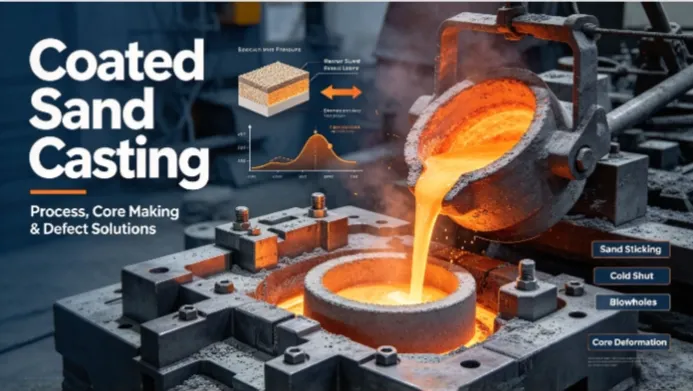
Coated sand casting has a long history in the foundry industry with massive annual casting output. Nevertheless, many challenges remain when producing precision steel castings via coated sand technology, including sand adhesion (scab), cold shut and blowholes. Further research is required to fully address these typical defects.
1. Understanding Coated Sand (Organic Binder Molding & Core Sand)
(1) Properties of Coated Sand
Coated sand delivers controllable strength and excellent flowability. It can produce mold and cores with sharp contours and dense structure, making it suitable for manufacturing intricate sand cores. The molded sand mold/core features superior surface finish with surface roughness Ra 6.3~12.5μm and dimensional accuracy CT7~CT9. It also has good shakeout performance for easy casting cleaning after cooling.
(2) Application Scope
Coated sand can be used for both molds and sand cores. Coated sand molds/cores can work with each other or be combined with other sand systems. It is applicable to gravity metal mold casting, low-pressure casting, iron mold coated sand casting and hot centrifugal casting. Besides cast iron and non-ferrous alloy castings, coated sand is also widely adopted for steel casting production.
2. Preparation of Coated Sand
2.1 Composition of Coated Sand
Coated sand mainly consists of refractory material, binder, curing agent, lubricant and special additives.
- Refractory material: The base component of coated sand. It requires high refractoriness, low volatile content, round and solid grain shape. Natural washed silica sand is commonly used. Requirements for silica sand: High SiO₂ content (>90% for cast iron & non-ferrous alloys; >97% for steel castings); clay content ≤0.3% for washed scrubbed sand; grain size distributed across 3~5 adjacent sieve sizes; rounded grain shape with angularity factor ≤1.3; acid demand value ≥5ml.
- Binder: Phenolic resin is the mainstream binder.
- Curing agent & lubricant: Hexamethylenetetramine (urotropine) acts as curing agent; calcium stearate serves as lubricant to prevent agglomeration and improve flowability. Additives are used to optimize overall sand performance.
Basic mass proportion formula: Base sand: 100% (scrubbed sand) Phenolic resin: 1.0~3.0% (based on base sand weight) Hexamethylenetetramine (aqueous solution): 10~15% (based on resin weight) Calcium stearate: 5~7% (based on resin weight) Additives: 0.1~0.5% (based on base sand weight)
2.2 Coated Sand Manufacturing Process
Three coating technologies are available: cold coating, warm coating and hot coating. Hot coating is the dominant method for mass production. The hot coating process: Heat base sand to target temperature, then mix sequentially with resin, urotropine solution and calcium stearate. After mixing, the mixture is cooled, crushed and sieved. The mixing parameters vary according to different formulations. China has abundant coated sand production lines: about 2000~2300 semi-automatic lines with manual feeding, and nearly 50 fully automatic computer-controlled lines, greatly boosting productivity and product consistency. For example, the automatic visual production line of XX Foundry Co., Ltd. controls feeding time within 0.1s and heating temperature accurate to 0.1℃. Operators can monitor mixing status in real time via video, reaching an output of 6 tons per hour.
2.3 Main Types of Coated Sand
- Standard Coated Sand Traditional quartz sand coated sand formulated with thermoplastic phenolic resin, urotropine and calcium stearate without special additives. It requires relatively high resin dosage to meet strength requirements, lacking high-temperature resistance, low expansion and low gas evolution. Suitable for general castings with low technical requirements.
- High Strength & Low Gas Evolution Coated Sand Features: High strength, low thermal expansion, low & retarded gas evolution, anti-oxidation. It is an upgraded version of ordinary coated sand. With special additives and optimized mixing technology, resin consumption is largely reduced while its strength increases by over 30%. Gas emission is significantly decreased and gas releasing speed is slowed down. It fits cast iron, medium & small steel and alloy steel castings. Series: GD-1 High Strength Low Gas Coated Sand; GD-2 High Strength Low Expansion Low Gas Coated Sand; GD-3 High Strength Low Expansion Low Gas Anti-oxidation Coated Sand.
- High-Temperature Resistant Coated Sand (ND Series) Features: High temperature resistance, high strength, low expansion, low & retarded gas evolution, easy shakeout, anti-oxidation. This new type of coated sand adopts special formulation and process, with outstanding high-temperature performance: high hot strength, long heat-resistant duration, low thermal expansion and low gas evolution. It is ideal for complex thin-wall precision iron castings (e.g. engine cylinder blocks & cylinder heads) and high-grade steel castings (container corner castings, train brake buffer housings). It effectively eliminates sand sticking, deformation, hot cracking and blowhole defects. Series: VND-1; ND-2; ND-3; ND-4.
- Easy Shakeout Coated Sand Balanced strength with excellent low-temperature shakeout property, mainly used for non-ferrous alloy castings.
- Special Custom Coated Sand Custom grades developed for special working conditions: centrifugal casting coated sand, chill coated sand, wet coated sand, anti-burning-on, anti-veining and anti-orange peel coated sand.
3. Core Making Process with Coated Sand
Typical process window: Heating temperature 200-300℃, curing time 30-150s, shooting pressure 0.15-0.60MPa. Simple cores or coated sand with good flowability can adopt lower shooting pressure. Thin delicate cores require lower heating temperature, with prolonged curing time as compensation. The binder used in coated sand is phenolic resin. Advantages of coated sand core-making: Adjustable strength, excellent flowability, good surface finish (Ra 6.3-12.5μm), strong moisture resistance and easy shakeout for casting cleaning.
3.1 Mold Temperature
Mold temperature is a key factor affecting shell thickness and core strength, normally controlled at 220~260℃. Setting principles: (1) Supply enough heat for resin softening and curing; (2) Form required shell thickness without surface carbonization of shell mold/core; (3) Minimize shell forming and hardening cycle to improve productivity.
3.2 Shooting Pressure & Shooting Time
Shooting time: 3~10s. Insufficient shooting time leads to incomplete filling. Shooting pressure is around 0.6MPa; low pressure causes underfilling or loose sand structure.
3.3 Hardening Time
Hardening time depends on core thickness and mold temperature, generally 60~120s. Short hardening time results in incomplete curing and low core strength; excessive time burns the core surface and damages casting quality.
Process parameter examples for coated sand shell molding:
- Guide Sleeve DN80-05: Shell thickness 8~10mm, weight 2.5~2.6kg, mold temp 220~240℃, shooting time 2~3s, hardening time 60~80s
- Valve Body DN05-01: Shell thickness10~12mm, weight3.75~3.8kg, mold temp240~260℃, shooting time3~5s, hardening time80~100s
4. Common Problems & Countermeasures in Coated Sand Application
Core-making technologies are divided into thermosetting and cold-setting categories. Coated sand shell core-making belongs to thermosetting process. Every core-making method has pros and cons. Selection depends on quality requirement, part complexity, batch size, production cost and target price. Coated sand core-making is highly recommended for castings requiring high inner surface quality, precise dimension and complex inner cavities, such as intake/exhaust port cores, water & oil passage cores for automotive cylinder heads and blocks, intake/exhaust manifold shell cores, hydraulic valve flow path cores and turbocharger airway cores. Several frequent issues encountered during practical application are summarized below:
4.1 Determination of Coated Sand Strength and Gas Evolution
With fixed base sand and resin quality, phenolic resin dosage dominates coated sand strength. Higher resin dosage brings higher strength, but increases gas evolution and worsens shakeout performance. We need to find a balanced target strength: enough strength to keep sand cores intact during handling and pouring without deformation or breakage, while minimizing gas emission to reduce blowhole defects and improve shakeout. Use transport racks and core trolleys lined with 10~15mm sponge to reduce core damage during storage and handling.
4.2 Shelf Life of Sand Cores
Sand cores absorb moisture, especially in high-humidity southern regions. Shelf life must be clearly defined in process documents. Adopt lean production FIFO (first-in first-out) rule to reduce stock quantity and storage cycle. Manufacturers shall define storage period according to workshop condition and local climate.
4.3 Quality Control of incoming Coated Sand
Each batch of incoming coated sand must come with supplier quality certificate. Carry out sampling inspection before warehousing. For unqualified batches, QA & technical team will decide whether to accept with concession or return to supplier.
4.4 Sand Core Breakage & Deformation with Qualified Coated Sand
Many people attribute core breakage or deformation merely to insufficient sand strength. In fact, multiple production factors are involved. Root causes and solutions: (1) Mold temperature and dwell time directly control shell thickness and curing degree. Adjust dwell time according to mold temperature: shorter dwell time at upper temperature limit, longer dwell time at lower temperature limit. Continuous operator training is necessary. (2) Resin and sand residue accumulate on mold surface. Clean mold regularly and spray release agent; otherwise residue will tear or deform cores during mold opening. (3) Spring ejector pins on hot box static mold lose elasticity after long-time high-temperature operation, causing core fracture. Replace springs timely. (4) Misalignment or non-parallelism between moving and fixed mold. Although mold can close under cylinder/hydraulic pressure, misalignment will break cores when opening mold and cause sand leakage and oversized core dimension. Adjust mold parallelism and concentricity. (5) For hollow cores made on shell core machines: uncured residual sand emptied from finished cores can be reused after sieving. Mix recycled sand with new coated sand at 3:7 ratio to guarantee surface quality and core strength.