
Sep 5, 2026Technical Articles
Advantages and Limitations of Fused Ceramic Sand Compared with Silica Sand and Main Special Foundry Sands
Comparison of pearl ceramic sand, silica sand, zircon sand, chromite sand, olivine sand and magnesia sand: advantages, limitations and application guidance for modern foundry production.
Introduction
Silica sand features abundant reserves, decent refractoriness and non‑wetting performance against molten metal. It still accounts for more than 90 % of total foundry sand consumption nowadays. Nevertheless, with higher requirements for casting quality, comprehensive cost control and environmental protection, its inherent drawbacks become prominent. It suffers poor thermal stability; phase‑change expansion easily brings veining defects. At high temperature, it reacts with iron oxide to form fayalite and causes metal penetration. Limited refractoriness restricts its application in medium‑high alloy steel and high‑manganese steel casting. Moreover, silica sand tends to fragment during service, and respirable silica dust may lead to silicosis among operators.
Since the 1940s, various special foundry sands have been developed to overcome silica‑sand limitations. Conventional natural special sands include zircon sand, chromite sand, olivine sand and magnesia sand. They generally deliver high refractoriness, good thermal conductivity, low thermal expansion and strong slag resistance. They are widely used as facing sand, coating aggregate and special cores for alloy steel and penetration‑prone carbon‑steel castings. These mineral sands are produced via ore dressing, crushing and screening (partially calcined) without essential change in mineral composition. Most of them have angular grain shape and poor reclamation performance, so they are mostly applied locally as facing sand rather than system‑wide total sand. In addition, natural special sands face shrinking mineral resources, stricter mining restrictions and rising market prices.
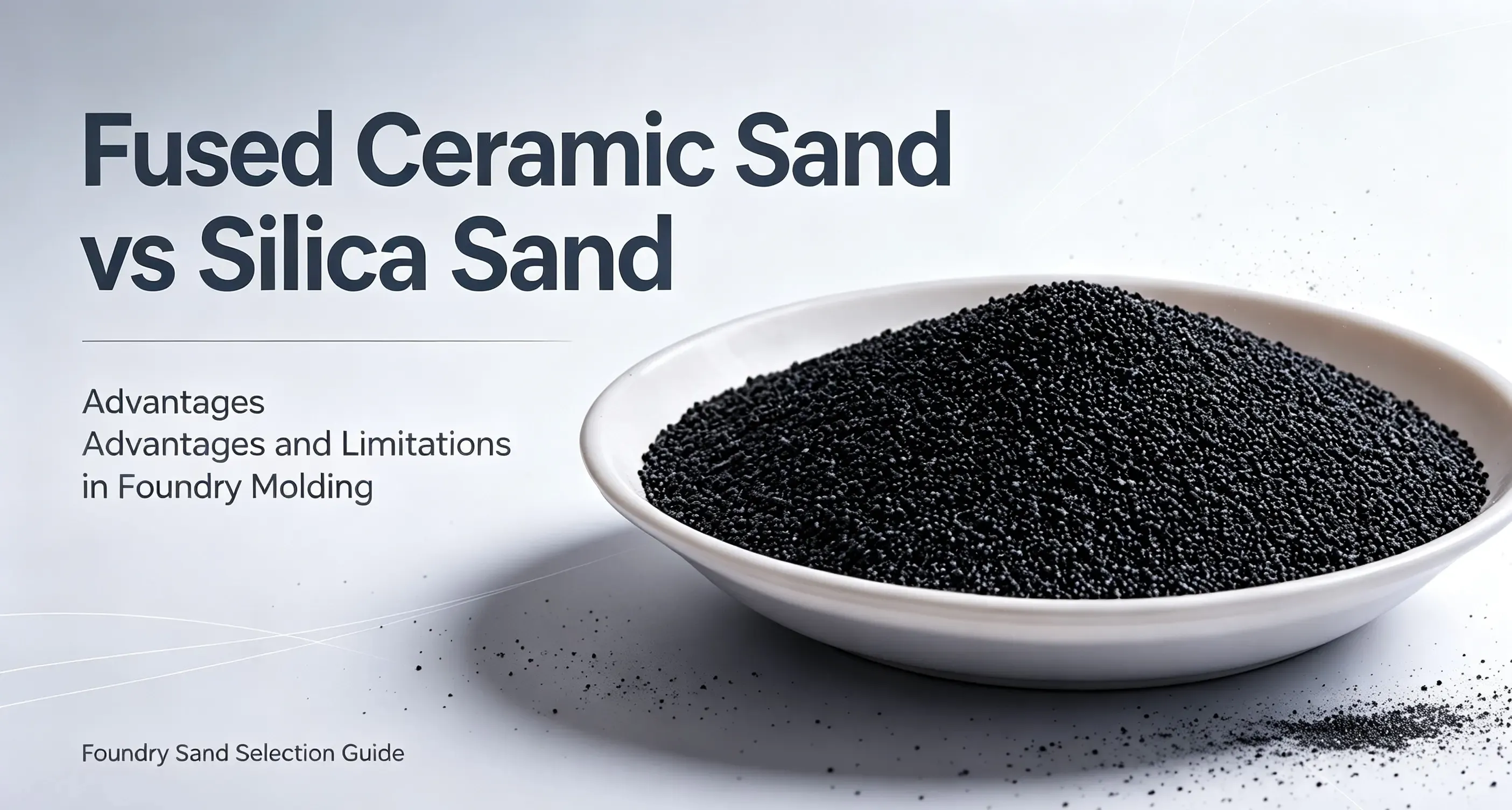
From the end of last century, enterprises and research institutes in China, Japan, Germany and other countries adopted bauxite or kaolin as raw materials to manufacture ceramic spherical artificial sand through granulation‑sintering or melting‑atomizing processes. Besides the merits of natural special sands such as high refractoriness and low thermal expansion, man‑made spherical sand provides good flowability, lower binder consumption, favorable permeability and high fragmentation resistance. It can be adopted in full production lines and has achieved rapid popularization over the past decade. Pearl ceramic sand (electric‑fused ceramic sand) stands out as the representative with the best comprehensive properties.
Advantages & Limitations of Main Foundry Sands
1. Silica Sand
✅ Advantages
- Huge mineral reserve with low procurement cost and easy access.
- Acceptable refractoriness for most cast iron and plain carbon‑steel castings.
- Compatible with nearly all binder systems: green sand, resin‑bonded sand, water‑glass sand.
- Recyclable via simple reclamation, lowest comprehensive cost for general castings.
❌ Limitations
- Sharp volume expansion at 573 ℃ phase transition, easily causing veining, sand‑inclusion and dimensional deviation.
- Acidic chemistry; reacts with FeO / MnO at high temperature to generate low‑melting silicates and trigger chemical metal penetration.
- Limited refractoriness, not suitable for high‑manganese steel and high‑alloy steel.
- Mostly angular grains; easy to pulverize during repeated cycles. Respirable silica dust causes silicosis, requiring heavy occupational‑health protection.
Application: General‑purpose cast iron, medium‑small carbon‑steel and non‑ferrous castings; mainstream aggregate for green sand and ordinary resin‑bonded sand.
2. Natural Special Sands
(1) Zircon Sand
✅ Advantages: High refractoriness, low thermal expansion, excellent chemical stability and penetration resistance; relatively rounded grains with good permeability. ❌ Limitations: Scarce resource and high price; trace radioactivity requires handling control; poor reclamation; mostly used as facing sand or coating aggregate instead of full‑mold sand. Application: Facing sand and coating for high‑grade steel castings.
(2) Chromite Sand
✅ Advantages: Ultra‑high refractoriness, outstanding thermal conductivity and chilling effect, low thermal expansion, excellent resistance against steel‑slag erosion. ❌ Limitations: Expensive scarce mineral; risk of hexavalent‑chromium formation under alkaline high‑temperature condition, classified as hazardous waste after use; angular grains raise binder demand; hard to reclaim, mainly for local facing sand. Application: Facing sand for heavy‑wall steel castings.
(3) Olivine Sand
✅ Advantages: Alkaline, good resistance against high‑Mn‑steel slag; lower price than chromite / zircon sand; free of silica‑dust hazard. ❌ Limitations: Moderate refractoriness; easy hydrolysis when exposed to moisture; angular grains; poor collapsibility and high reclamation loss. Application: Facing sand for high‑manganese‑steel castings.
(4) Magnesia Sand
✅ Advantages: Strong alkalinity, outstanding resistance to alkaline slag, high refractoriness. ❌ Limitations: Large thermal expansion; highly hygroscopic and easy to pulverize; high cost; strict storage requirement; seldom used as molding sand, mostly for coating. Application: Coating aggregate for steel castings.
Summary: Natural special sands deliver good high‑temperature performance, yet limited by resources, angular morphology, poor reclamation and environmental risks. Most can only serve as partial facing sand instead of total system sand.
3. Pearl Ceramic Sand (Electric‑Fused Spherical Ceramic Sand)
✅ Advantages
- Nearly perfect spherical grain shape (angularity factor ≈1.1) with excellent flowability. Small specific surface area reduces resin binder consumption by 30‑40 %, lowering gas evolution and porosity risk.
- Extremely low thermal expansion, effectively suppress veining and sand‑inclusion, improving casting dimensional accuracy.
- Refractoriness ≥1790‑1850 ℃, near‑neutral chemistry. Suitable for cast iron, carbon steel, stainless steel and high‑manganese steel with good anti‑penetration performance.
- High hardness and fragmentation resistance. Thermal reclamation rate reaches 95‑98 %, drastically reducing waste‑sand output. Can replace silica sand for full‑line production instead of only local facing sand.
- Free of free silica, eliminating silicosis hazard for better workplace environmental performance.
- Compatible with resin self‑hardening sand, resin‑coated sand, cold‑box, lost‑foam, V‑process and binder‑jet 3D printed sand molds.
❌ Limitations
- Higher virgin‑sand purchase price compared with silica sand. Its overall cost advantage relies on high reclamation rate. Foundries without reclamation equipment face higher one‑time investment pressure.
- Inferior chilling capacity vs chromite sand. Partial chromite facing sand is still required for certain heavy‑section steel castings demanding grain refinement.
- Quality varies greatly among suppliers. Raw‑material bauxite and melting‑process control determine final sand performance, so careful vendor selection is necessary.
Application: High‑quality cast iron / carbon‑steel / alloy‑steel castings with strict surface & dimensional requirements; applicable for resin sand, cold‑box, resin‑coated sand, lost‑foam and 3D‑printed sand molds; available as full‑system sand instead of only facing sand.
Summary Table
表格
Sand Type | Main Composition | Grain Shape | Thermal Expansion | Refractoriness | Reclaimability | Main Drawbacks | Typical Usage |
|---|---|---|---|---|---|---|---|
Silica Sand | SiO₂ | Angular | High | Medium | Fair | Phase‑change expansion, silicosis hazard, chemical penetration | General cast iron & medium‑small carbon‑steel parts |
Zircon Sand | ZrSiO₄ | Sub‑rounded | Low | Very high | Poor | High cost, trace radioactivity | Facing sand & coating for steel castings |
Chromite Sand | FeCr₂O₄ | Angular | Low | Ultra‑high | Poor | High cost, hexavalent‑Cr environmental risk | Facing sand for heavy‑wall steel castings |
Olivine Sand | Mg‑Fe silicate | Angular | Medium | Medium | Poor | Hydrolysis risk, limited refractoriness | Facing sand for high‑Mn‑steel castings |
Magnesia Sand | MgO | Angular | High | Ultra‑high | Poor | Strong hygroscopic pulverization | Steel‑casting coating aggregate |
Pearl Ceramic Sand | Electric‑fused Al₂O₃ | Spherical | Very low | Very high | Excellent | High virgin‑sand cost, weak chilling effect | Full‑system sand for high‑end castings, 3DP, lost‑foam, cold‑box |
Conclusion
Silica sand remains the dominant general‑purpose foundry sand due to resource and cost merits. Nevertheless, its drawbacks including expansion‑related defects, metal‑penetration and occupational‑health risks cannot be ignored for high‑precision steel / alloy‑steel and complex thin‑wall castings.
Natural special sands show outstanding refractoriness and slag resistance, yet they are mostly limited to partial facing‑sand application because of mineral‑resource constraints, angular grains, poor reclamation and environmental concerns.
Benefiting from spherical morphology, low thermal expansion, high refractoriness and superior reusability, pearl ceramic sand can work not merely as facing sand but as total system sand to replace silica sand across whole production lines. Although virgin‑sand purchase cost is higher, its high reclamation rate lowers total ton‑sand cost. It demonstrates remarkable comprehensive advantages for high‑quality castings, 3D‑printed sand molds, lost‑foam and cold‑box processes. For heavy‑section steel castings requiring strong chilling effect, partial combination with chromite facing sand is recommended.
To learn more about pearl ceramic sand specifications and process matching suggestions, please visit our Pearl Ceramic Sand product page. Visit Fused Ceramic Sand Product Page